

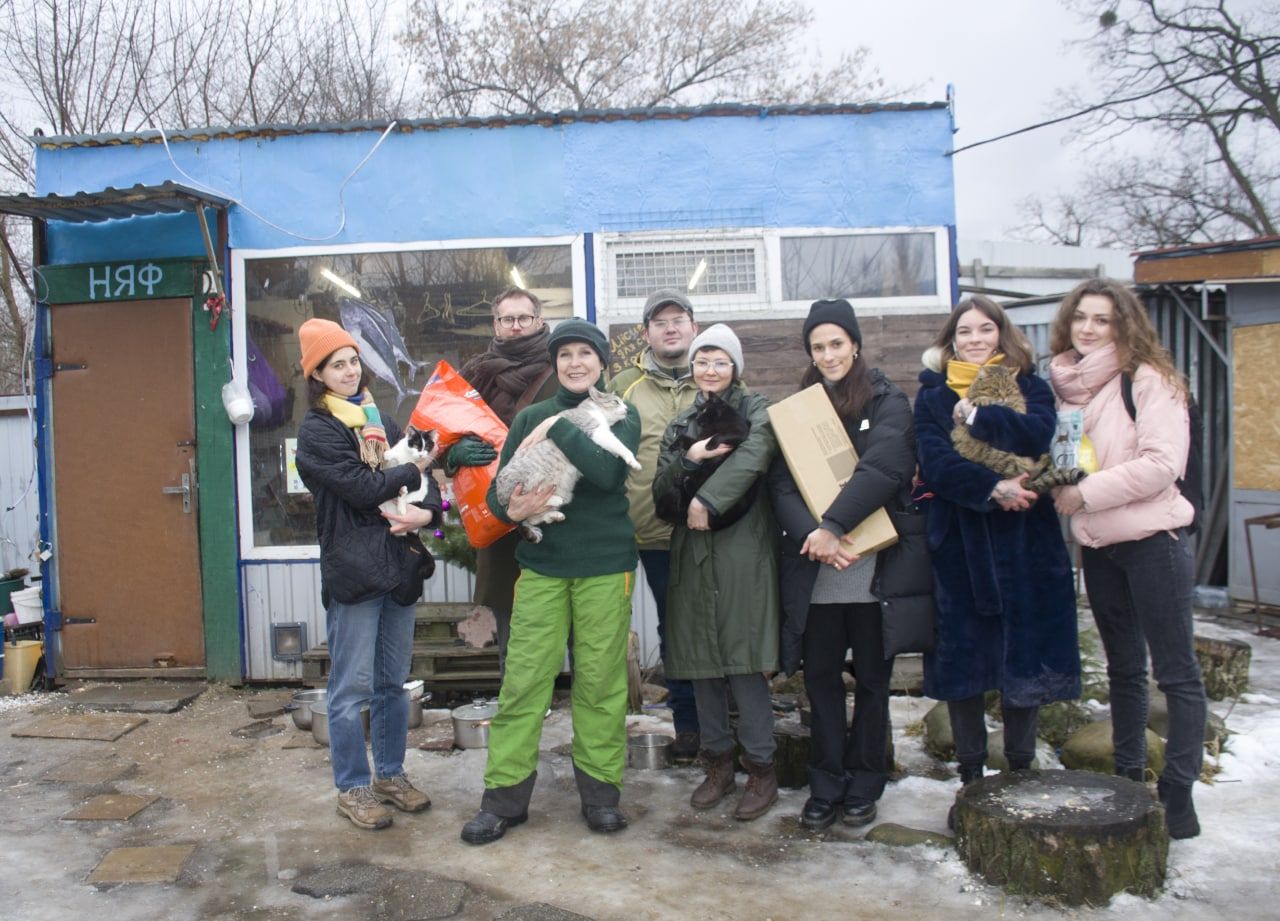
On February 10, 2022, we were visited by the editorial staff of Platfor.ma.
These wonderful people presented us with a bactericidal lamp (worth 5990 UAH) and food. They also volunteered as cat sitters. :-)
They wrote an article about us after the “full-scale” russian invasion started. Introducing this article.
***
The Zoocats (Cat Town) project has existed since 2010, when activists began to take care of the [stray] cats that settled in the Kyiv Zoo. Later, it grew into a well-equipped and functional, but still unfinished, shelter with 120 residents before the war. A week before the war, Platfor.ma editorial team visited the Cat Town, learned the history of the initiative and how to help the cats. After the invasion began, the ZooCats continued their work, and now they need support even more than before. Here is the story.

CHARACTERS
“I am a philosopher and political scientist, Anzhelika is a philologist. We are two humanitarians trying to tighten screws and lay pipes,”
says animal rights activist Oleg Andros, who meets us at the Kyiv Zoo at the side entrance.
Oleg was at the origins of Cat Town and has been fighting for the right to at least some place in the sun for furry animals since 2010. And Anzhelika is Anzhelika Komarova, the ideologist and founder of the Cat Town project. The two met back in 2005 at a picket outside the Kyiv City Council, when they were protecting Protasiv Yar and other green areas of the capital from development.
“Everything I've gained in my life - skills, knowledge, education, ways of communicating with people, social capital, etc. - was all put on the altar of serving cats,” Anzhelika admits.

Зоозахисник Олег Андрос
 Засновниця Котомістечка Анжеліка Комарова
BACKGROUND
In 2010, journalist and environmental activist Anzhelika was invited to work at the zoo as the head of the press service after a series of critical articles she wrote about the situation of animals there. They said that new management had come in and that everything would be actively changing. Something did change – for example, after Angelika launched an appeal, patrons donated a TV set for Tony the gorilla, which he loved. He watched various nature movies, mostly about other monkeys. However, Anzhelika also covered some troubles, which the management did not like, because a press secretary is supposed to always smile and be happy with everything.
“Since childhood, I've been used to protecting animals, so I couldn't do that, so I couldn't keep silent about the zoo's problems and the developers' media campaign against it,” says Anzhelika.
In particular, the journalist decided to solve the problem of the huge number of cats in the zoo. At first, Anzhelika proposed to civilize the sterilization of animals, which has been done in Kyiv since 1995. So she developed a project to keep track of cats and medical procedures. However, she received the following response: “We don't have time for that.” Moreover, she was gradually told that until 2010, these cats were periodically destroyed.
“I had to speak to the administration more firmly and threaten an international scandal. Then they gave up: let her take care of her cats. So I did, and continued to do so after my official work at the zoo ended in 2014. It was getting ridiculous. Back then, the guards took me back and forth under escort to feed the cats,” Anzhelika recalls.
Silver Silver in Angelika's arms was a wild and distrustful cat a year ago. And the girl's tabby Zhuzhman on the right was not very eager to be picked up until recently.
Now they are ready to be adopted)) And Marsik in the center and Grom on the left have been stroked since they were young and are always ready for good hands))
The activists tried everything to persuade the zoo administration: they negotiated with officials, made arguments, twice passed the Kyiv City Council's environmental commission, even offered the idea of a cat café and cited the American project CaboodleRanch, where about 600 cats live on a ranch. However, they were not heard. It was only in 2017, when construction work began at the zoo, that Anzhelika and her team organized two loud pickets, and then they and the cats were “temporarily” allowed to live on the territory on the outskirts of the zoo.


THE TERRITORY OF THE CAT TOWN
Oleh noted that officially it is called “the economic territory of the Kyiv Zoo” (the activists themselves refrain from such officialdom), but the historical name is Shuliavska Balka. The director himself suggested this place as a temporary option, but this option has been around for five years. The NGO “Nature Above All”, the curators of the Cat Village, has no contract with the zoo (only a protocol of intent from 2018), so there are no guarantees either.
“In 2017, we started to move our small property from the center of the zoo: cats and self-made houses that were in the unfinished monkey house. Some cats had to be caught with nets, and three “rebels” still live on Zoolohichna Street because they refused to move - Anzhelika feeds them separately,” Oleh recalls.
The Cat Town was built from scrap materials: boards, Soviet wardrobes, old furniture, fences - everything was used. In 2017, volunteers and like-minded people managed to build a fence and give the town the look it has now.
The shelter consists of three courtyards based on the principle “live in the house - walk in the garden”. In the first yard, there is an isolation room where the smallest cats and those who need to be kept or treated live. There is also an administrative building with a sign that says NFU: a cross between “meow” and “MAF”. In the next two yards, there are old and new homes for cats. Among the old ones there are three kiosks that were transferred to the KCSA for storage. The new ones are tool houses that were sold at Leroy Merlin.
“We raised money for the new ones with the help of donations from people who care on social media. Plus, Leroy Merlin gave us a discount. However, for some reason, building materials are still very expensive in a poor country like ours,” the animal rights activists say.
Each house has a heater, cat furniture, special doors (so that cats can enter without opening “human” doors), litter boxes and bactericidal lamps that kill infections. The new buildings are insulated and scratch-proof.
In one of the yards there is a cat garden, a kind of jungle where cats like to walk in the summer. The activists also hold koto yoga, a conversation club and movie screenings here.


FINANCING
Initially, the project was funded by Anzhelika's personal funds, and then some patrons appeared. For example, the Goodwine company donates 15 thousand UAH every month (after the outbreak of war and the destruction of warehouses, the company lost the opportunity to be a patron). Kotomistechko is also listed on the Kind Challenge project page, where you can also donate money to help cats, and has an account on the charity platform Patreon, and after the legalization of the PayPal payment system in Ukraine, it also has an account there.
However, a good half of the donations are still raised through Facebook and Twitter. This money is spent primarily on food. Every day, the cats eat 4 kg of dry food and about 8 kg of meat food - offal: chicken necks or heads, fish. The second constant expense is veterinary care. To physically take a cat and leave it in a hospital costs from 120 UAH per day (pre-war prices).
“We are faced with the fact that infectious diseases snatch someone out of their normal cat life - we have to drop everything and take the cats to the veterinary hospital. Veterinary medicine is very expensive nowadays, so sometimes we have to do everything ourselves. We already know how to treat abscesses and infectious diseases of the same type, for example. We treat them for five days, see the result, send the doctor a photo, and he approves,” says Anzhelika.
The third expense item is repairs, which seem to never end. The founders of the initiative also have a dream of collecting sorted waste.

RESIDENTS
Officially, Kotomistechko is a shelter. According to the zoo's charter, it cannot rescue stray animals, nor can it own a shelter. Before the war, there was an overpopulation in Cat Town – about 120 residents lived there in 2021, and as of February 2022, there were one hundred cats. For comparison, when the project came to Shuliavska Balka in 2017, the number was half that. Then pregnant cats gave birth and were not sterilized in time, and when the initiative was actively publicized in the media, the animals were abandoned.
“We were featured on a national TV channel with the ‘Looking for a Cat Sitter’ campaign, although we did not expect such publicity. On the one hand, there were people who fell down, and on the other hand, there were abandoned cats. The media also accidentally misled people, because we received calls asking, “Is it true that you pay 500 pounds in salary and provide a dormitory? I saw it on TV myself.” Since then, we have deliberately not invited television, but rather use social media,” Oleh recalls.
The main residents of Kotomistechko are actually 120 (now 40) cats. Most of them are quite welcoming to the guests, allowing them to be stroked, climbing on their arms, shoulders and heads, meowing and rubbing against their legs. Anzhelika notes that she knows all of them by name, because when you spend a lot of time with them for so many years in a row, you start to distinguish even twin cats.
There's a gray cat named Sierra or Glasgow, who has a sore eye. Madonna, who was named so because she was found in a box with a small kitten. Muri, who was named after the poet Vladyslav Khodasevych's cat Murra. Pumochka – because she looks like a cougar. Red and Ginger are super-red twin brothers. Archina, Sheri, Lerochka, Hilda, Marsik – it seems that no nickname has ever been duplicated.
“Unfortunately, we get more animals than we give away. For example, during the whole summer, maybe 2-3 cats were given away, and in the fall-winter period – about a dozen. But in fact, more than 11 cats were abandoned. When people have no conscience, they shift their responsibilities onto other people's shoulders,” notes Anzhelika.
The state is aware of the problem of a large number of stray cats in Kyiv. By the way, it is exactly five years since the Kyiv City Council decided to recognize cats as part of the capital's ecosystem. Last year, they even actively built an Animal Protection Center. However, according to the activists, there is still a lack of full-fledged work in this regard.
“The problem of stray cats should be solved systematically. It should be regulated by the state policy. Since 1995, all Kyiv mayors have declared that a municipal shelter should be created. However, all this disappeared in a swamp of corruption, silence, conflicts, and no one really wanted to do anything about it. After the Maidan, there was another wave of “Let's finally deal with this issue".
But it passed quickly. As an organization, we are not yet systematically solving the problem, it is only our dream. All we are doing is trying to get water out of a burst pipe,” Oleg is sure.


HELP
The project is constantly in need of help. We always need to do something: build a box, a shelf, an opening, construct cat furniture and lay linoleum. So far, most of the construction materials are just lying around.
“We have our own circle of volunteers, it just changes over the years. Volunteering is a temporary phenomenon. People get burned out, start families, build careers, move away – and that's okay. I appreciate any support. Even if a person supports me with a word or comes to help for an hour, I'm happy,” says Anzhelika.
To become a volunteer at Kotomistechko, you just need to write to their Facebook page, call them, or just come with food or a desire to do something, having called in advance. The space is open every day from 13:00 to 16:00 (the schedule is unstable during the war, so check in advance).
People help not only with money and their own efforts. Many donate simple things that the volunteers wear while working, or goodies. For example, the NGO “Divyvizhni” donated a large brown board to the initiative - they did not need it, but it became a photo zone for the Cat City.

PLANS FOR THE FUTURE
“We have a very ambitious project, so dreams have to become plans, and plans have to have a material basis. We see a large, spacious area in the wilderness: a landscape covered with various trees and lakes. And everything around is decorated with these beautiful little creatures. There are many insulated houses around, and among them is the largest one, which may become the first cat museum in Ukraine. A museum is not just a dead institution where exhibits are collected. It should be an educational center where charity and music evenings, poetry readings, festivals, concerts, animalistic vernissages, auctions, etc. could be held.
It should be a place where art is constantly present, because art and cats are a perfect tandem. I see it as a big elegant castle, because cats are masterpieces created by nature itself. They are beautiful and deserve luxury. They should be free to roam everywhere and find shelter in warm houses. We would like children from families in difficult life circumstances and children from wealthy families to come to this castle. We would like them to communicate with each other and have something to unite them,” Anzhelika dreams (or plans).


WAR
During the first three weeks of the war, Cat Town was switching to wartime operations and simultaneously looking for opportunities to evacuate cats to Europe.
Because the left bank of the capital was “cut off” from the right bank, only volunteers from the right bank visited the zoo for the first week. At the same time, the activists were looking for places to buy food and litter, which naturally disappeared from store shelves. And the stores with food were rapidly closing.
At first, the search for evacuation options was like hitting a wall. Zoocats had no transportation, no cages and carriers for 100 cats, and no diapers. Moreover, the vaccines that were ordered before the war were supposed to arrive on Friday, February 25. That is, they did not reach Kyiv.
But gradually, after several posts on all social networks, volunteers gathered a whole international community of patrons who helped with the evacuation. A lady from the charity organization Transform a Street Dog in the United States sent money, which became the final argument in favor of “going”. The NGO Veterinarians Without Borders from Canada wrote to the post office itself. My friends added other friends to the work chat, and that's how we found the Centaurus organization in Poland, Auxilium Animalis e.V. in Germany, and a private individual in Belgium who took the initiative to help.
Oleg Andros, as an English-speaking volunteer, coordinated the evacuation directly from the front line, where he had been going since the first days. Angelika, Maryna and other volunteers made their way to Cat Town every other day, often by taxi (recently, they have been cycling from the left bank to the right bank).
The situation with the export of animals to the EU has been constantly changing. At first, the Europeans allowed all pets to be brought in, without chips, passports, and without vaccination (injections were made at the border). Then the West remembered the rules and returned mandatory passports and the requirement to inject vaccines in Ukraine.
Finally, the cats were transported in one bus on March 17-18. Everyone showed heroism: volunteers Maryna and Olya (the latter evacuated her two children as well), who accompanied the cats; the driver who took everyone through the checkpoints despite the risks; and European partners: the Centaurus organization from Poland, which transported the cats across the border in two “walks”; volunteer Carole from Belgium, who came in a minivan to pick up our people; volunteers from Berlin and the UK.
The situation is still ongoing. 62 cats are currently in quarantine in Poland. In a month, when it ends, we have to place them in good hands or transport them to shelters in the EU. There are still 40 cats in Kyiv who did not go to Europe - some because of their health, others because of their wildness.
Therefore, the traditional request of Zoocats for help with food, litter, vaccines and veterinary services is constantly relevant. Links to all resources, social networks and financial details are here.
“Society is changing. We are beginning to think more and more about the fact that not only people should be comfortable, but also animals,” summarizes the Cat City. They feel pain, fear, boredom, they get attached, they love. How can you not treat them like a human being?”
Photos: Bogdan Magdych.